kNN Robust Losses
The kNN robust loss makes the training labels more robust to noise. For each instance it mixes the cost vector with the costs of its nearest neighbors in feature space and re-solves on the mixed costs, so the stored solution and objective labels are local averages rather than single-instance values.
What Changes
The usual optDataset stores one optimal solution and objective value for
each instance. optDatasetKNN instead computes neighborhood labels:
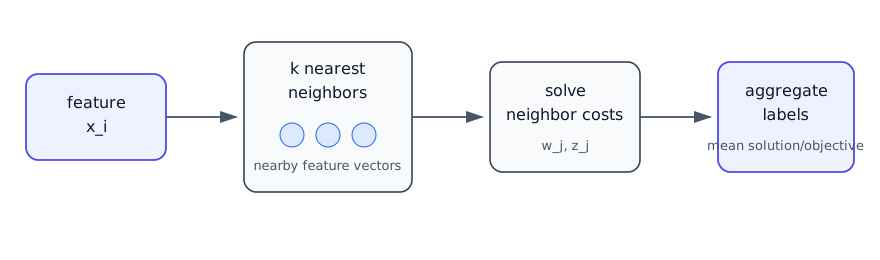
This setting applies when nearby feature vectors are expected to have similar decisions, but individual labels may be noisy.
Minimal Example
Use pyepo.data.dataset.optDatasetKNN in place of optDataset:
import pyepo
import torch
from torch import nn
from torch.utils.data import DataLoader

optmodel = pyepo.model.shortestPathModel((5, 5))
feat, costs = pyepo.data.shortestpath.genData(
    num_data=1000,
    num_features=5,
    grid=(5, 5),
    deg=4,
    noise_width=0.5,
    seed=135,
)

dataset = pyepo.data.dataset.optDatasetKNN(optmodel, feat, costs, k=10, weight=0.5)
dataloader = DataLoader(dataset, batch_size=32, shuffle=True)

predmodel = nn.Linear(5, optmodel.num_cost)
spo = pyepo.func.SPOPlus(optmodel, processes=2)
optimizer = torch.optim.Adam(predmodel.parameters(), lr=1e-3)

for x, c, w, z in dataloader:
    cp = predmodel(x)
    loss = spo(cp, c, w, z)
    optimizer.zero_grad()
    loss.backward()
    optimizer.step()
Parameters
ksets the number of neighbors used for each aggregate label.weightis the self-weight in the mix:weight=1keeps the original cost (no smoothing), and smaller values pull the cost toward the neighbors.
The batch format is the same as optDataset: (x, c, w, z). Methods that
already consume optDataset batches can consume optDatasetKNN batches
without changing the training loop.