CaVE
CaVE is a training loss for binary linear programs. It uses the binding
constraints at the true optimum as supervision for the predicted cost vector.
optDatasetConstrs prepares these labels, and the CaVE loss consumes
them during training.
What CaVE Uses
For a linear minimization problem, a binary solution remains optimal when the negative predicted cost lies in the cone generated by the binding-constraint normals at that solution. CaVE uses this condition directly:
true cost c
    -> true optimal solution w*
    -> binding constraints at w*
    -> cone of binding-constraint normals
    -> CaVE loss for predicted cost c_hat
The dataset stores the cone information. During training, CaVE projects the
sense-flipped predicted cost onto that cone and penalizes the angle between the
prediction and the projection.
Minimal Example
CaVE uses pyepo.data.dataset.optDatasetConstrs instead of optDataset.
It adds tight_ctrs, the binding-constraint normals at the true optimum,
to the usual (x, c, w, z) batch.
The number of binding constraints can differ across instances, so the batch
needs padding. optDataLoader applies the padding automatically. An existing
DataLoader can instead pass collate_fn=collate_tight_constraints:
import pyepo
import torch
from torch import nn
from pyepo.data.dataset import optDatasetConstrs, optDataLoader

# TSP model; Gurobi backend required for binding-constraint extraction
optmodel = pyepo.model.tspModel(num_nodes=10, formulation="DFJ")

# synthetic TSP data
feat, costs = pyepo.data.tsp.genData(
    num_data=1000,
    num_features=5,
    num_nodes=10,
    deg=4,
    noise_width=0.5,
    seed=135,
)

# CaVE dataset and padded batches
dataset_constr = optDatasetConstrs(optmodel, feat, costs)
dataloader_constr = optDataLoader(dataset_constr, batch_size=32, shuffle=True)

# linear predictor and CaVE loss
predmodel = nn.Linear(5, optmodel.num_cost)
cave = pyepo.func.CaVE(optmodel, processes=1)
optimizer = torch.optim.Adam(predmodel.parameters(), lr=1e-3)

for x, c, w, z, tight_ctrs in dataloader_constr:
    cp = predmodel(x)
    loss = cave(cp, tight_ctrs)
    optimizer.zero_grad()
    loss.backward()
    optimizer.step()
Solver Requirements
CaVE currently targets binary linear programs. Extracting binding-constraint
normals requires a Gurobi-backed optModel. optDatasetConstrs raises on
infeasible instances or non-binary optima. Pass skip_infeas=True to drop
such instances instead.
Clarabel is used internally by the CaVE loss for the cone projection during
training. max_iter caps the Clarabel iterations. The default max_iter=3
is the paper’s CaVE+ preset, which under-converges the projection on
purpose so it stays interior to the cone. Raising it changes the loss, not
just its precision. Setting solve_ratio < 1 enables the CaVE-Hybrid
update, which uses the QP projection only for a fraction of batches and a
blended update for the remaining batches.
Performance Example
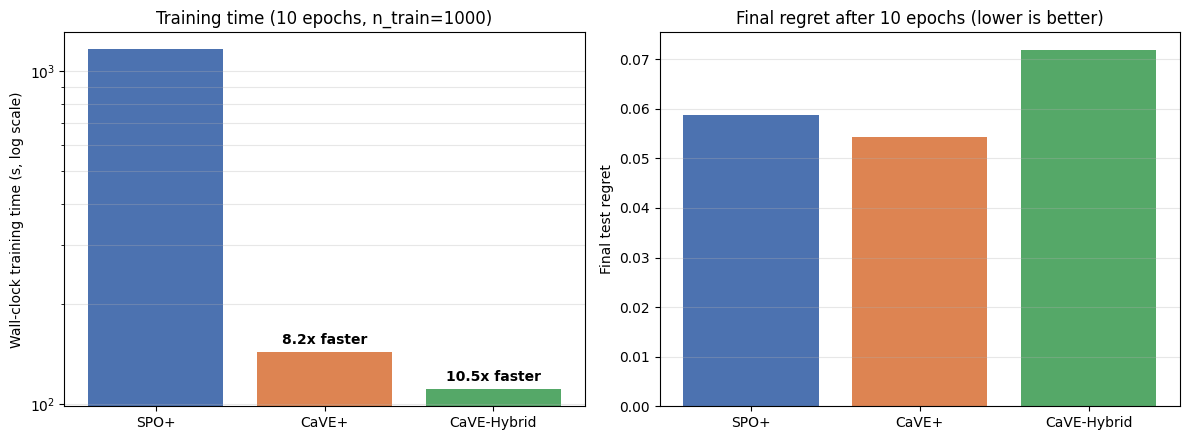
CVRP-20 results from notebook 04: num_data=1000, 10 epochs, single process.
In this setup, CaVE+ trains 8.2x faster than SPO+. CaVE-Hybrid with
solve_ratio=0.3 trains 10.5x faster than SPO+, with a final regret higher
than both.